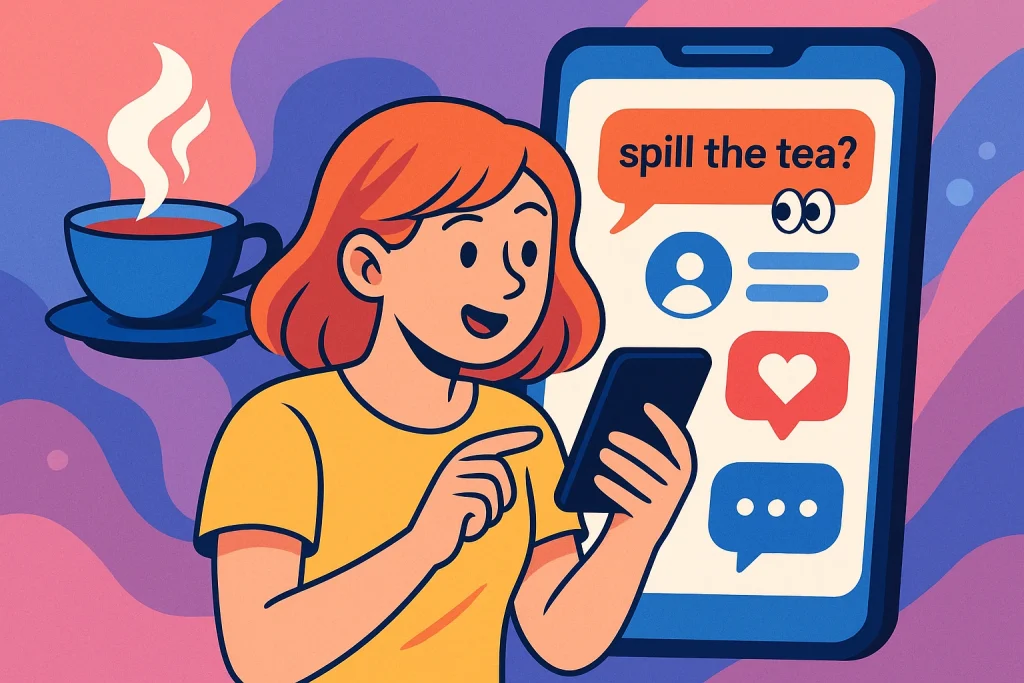

“Spill the tea” means to share gossip, inside information, or juicy details about a situation or person, usually in a playful way. When someone comments “Spill the tea 👀” under a post, they’re basically saying, “Okay, tell us what really happened.”
What Does “Spill the Tea” Mean on Social Media? (Quick Answer Explained)
Most people use it in informal spaces: TikTok storytimes, Instagram captions, YouTube drama videos, Twitter/X threads, group chats, and DMs. It usually shows up around relationship drama, influencer beef, celebrity news, or work gossip—any situation where people know there’s more to the story than the polished version. On social media, you’ll see it in a few common ways:
-
As a request for details:
“Bestie, spill the tea—what went down at that party?” -
As a promise of drama:
“I’m about to spill the tea on why I quit my job…” -
As a noun, not a verb:
“That’s some serious tea.” = That’s some wild gossip or surprising truth.
But does it always mean messy gossip? Not necessarily. In 2025 usage, “tea” can also be light, positive “life updates,” or honest behind-the-scenes info, especially in creator and brand content.
The Origin of “Spill the Tea” and Why the Meaning Matters Online
In the late 20th century, especially in Black gay and ballroom communities in the US, people used “T” as shorthand for truth—your real story, your business, sometimes your identity. Over time, that “T” started to be written and pronounced as “tea,” and it picked up a second meaning: not just your own truth, but the hidden truth about others—aka gossip.
From there, phrases like “what’s the tea?” and “no tea, no shade” spread through drag culture, including shows and performances that mixed sharp humor with real talk. When RuPaul’s Drag Race became a global hit in the 2010s, that language reached a much wider audience, and suddenly you had mainstream viewers repeating drag slang on Twitter, Tumblr, and later TikTok.
So why does this origin story matter and not just feel like trivia? Because in 2025, a lot of Gen Z and brand accounts casually drop “spill the tea” with zero awareness that it’s rooted in Black and queer communities, not just “the internet in general.
How “Spill the Tea” Became a Social Media Trend Across TikTok, Instagram, and More
“Spill the tea” went from niche queer slang to everyday internet language because social platforms love two things: drama and catchphrases. Once those met, the phrase never really stood a chance of staying underground.
In the early 2010s, the expression started popping up more on Twitter and Tumblr, often paired with screenshots, confession threads, and fandom drama. People used it as a kind of green light: okay, you’re allowed to tell us what really happened now. As feeds sped up and culture grew, “tea” became shorthand for “the real story behind this mess,” especially around celebrities and YouTubers.
Then came the memes. The Kermit sipping tea image — the “But that’s none of my business” meme — helped lock “tea” to gossip in the public mind. You see a frog, a mug, and a side-eye caption? You instantly know someone’s about to drop some not-so-subtle commentary. That visual made “tea” feel like a whole vibe, not just a word.
From there, it spread to YouTube drama and tea channels, which literally brand themselves around “tea” as a term for internet controversy and creator gossip. By the early-to-mid 2020s, TikTok picked it up and ran with it: storytime videos, “get ready with me while I spill the tea,” and POV skits where the punchline is always some piece of messy news.
So now, in 2025, “spill the tea” isn’t just a phrase. It’s a content format. It signals transparency, drama, and a little bit of theater—exactly what keeps people watching, scrolling, and asking for “part 2 pls.”
How to Use “Spill the Tea” on Social Media Without Sounding Awkward
Only use “spill the tea” in casual, informal contexts—friends, followers, and audiences who expect slang. It’s not for job interviews, client emails, or anything that feels like a LinkedIn post in disguise.
Here’s how it shows up naturally:
-
As a request for details
You’ve hinted that something happened. People reply:-
“Okay but spill the tea, what did he say?”
-
“Group chat later, I need the tea on this ”
-
-
As a promise in hooks and captions
Creators and influencers often use it as a hook to signal a storytime or confession-style video:-
“Storytime: I’m finally spilling the tea on why I left that brand deal.”
-
“Get ready with me while I spill the tea on my worst date ever.”
-
-
As a reaction when someone else drops info
When a friend or creator reveals something wild:-
“Omg that tea is boiling.”
-
“Thanks for spilling the tea, I knew something was off.”
-
Variations of “Spill the Tea”: ‘The Tea,’ ‘Hot Tea,’ ‘No Tea, No Shade,’ and More
All these phrases orbit the same idea—gossip and truth—but each one tweaks the tone. Some sound playful, some shady, some almost polite.
“The tea” – gossip as a thing
When people say “the tea”, they’re treating gossip like a noun:
-
“What’s the tea?” = What’s the gossip / what’s the truth?
-
“That’s some wild tea” = That’s some intense information.
“Hot tea”, “weak tea” – how strong is the drama?
These are about intensity.
-
Hot tea / piping hot tea – fresh, dramatic, high-stakes gossip.
-
Weak tea – boring, already-known, or not that serious.
Writers and lexicographers now use these terms to describe how exciting or disappointing a bit of gossip feels. You’ll see comments like, “That’s weak tea, give us the real story,” or “This tea is boiling, I wasn’t ready.”
“No tea, no shade” – “no offense, but…”
“No tea, no shade” basically means no offense / I’m not trying to be messy here. It’s saying: I’m not spreading gossip (“tea”) or being subtly insulting (“shade”); I’m just stating my opinion.
Drag performers and queer creators helped push this phrase into mainstream culture, and you’ll still hear it online as a softer way to disagree:
“No tea, no shade, but that outfit really isn’t working.”
Instagram comments are full of shorthand like “spill the tea,” “TB,” and other abbreviations — and if you’ve ever wondered about those too, here’s what TB means on Instagram.
When Not to Use “Spill the Tea” on Social Media (Etiquette & Boundaries)
A few red lines are pretty clear in 2025, especially in teen safety guides and online parenting resources:
-
Serious or traumatic topics
If the situation involves abuse, grief, self-harm, illness, or outing someone, “spill the tea” trivializes real pain. Safety experts warn that turning these stories into “tea” encourages harmful oversharing and glamorizes other people’s trauma. -
Stuff that isn’t your story to tell
Online-safety articles now lump “tea” in with doxxing and rumor-spreading when people share private info without consent—breakups, mental health, family drama, even grades or job issues. If sharing it could damage someone’s reputation at school or work, it’s not “tea,” it’s just gossip with consequences. -
Public dogpiles
Comment sections that chant “spill the tea” at creators can push them to expose names, workplaces, or ex-partners on camera. Digital well-being pieces now call this out as a form of crowdsourced pressure that can quickly become harassment.
Can Brands Use ‘Spill the Tea’ on Social Media? A 2025 Guide
Yes, brands and creators can say “spill the tea” — but only if it fits their voice and they use it respectfully.
In 2025, you’ll see the phrase all over influencer marketing glossaries and campaign case studies, usually framed as a hook for “juicy behind-the-scenes info” or honest storytelling. Brands from tea companies to tourism boards have run “spill the tea”–style campaigns, inviting people to share experiences, reactions, or insider stories, often via user-generated content and influencer collabs.
But Gen Z is brutally fast at spotting cringe or fake “youth speak.” Current Gen Z language and marketing studies all say the same thing: slang only works when it feels authentic to the brand, not slapped on top like glitter. If your usual tone is formal, suddenly yelling “spill the tea on our new product!!” will land… weird.
If you’re a creator or brand building an audience on Instagram, understanding platform culture matters — especially when you’re growing or investing in accounts from trusted marketplaces like our Instagram accounts for sale category.
FAQ – The Messy, Confusing Bits About “Spill the Tea”
Here are the things people actually argue about on Reddit, forums, Quora, etc., boiled down collected by InstaDeal:
Is “spill the tea” rude or disrespectful?
It can be. The phrase itself is neutral slang for sharing gossip, but when you push someone to “spill the tea” about sensitive or traumatic stuff, it crosses into pressure, privacy invasion, or even bullying. Recent work on “spill the tea” and privacy on Twitter points out how easily it turns serious conflicts into entertainment.
Is “spill the tea” the same as “spill the beans”?
Not quite. “Spill the beans” is about accidentally revealing a secret; “spill the tea” is more like deliberately sharing juicy gossip, drama, or the “real story.” That’s how native speakers explain the difference in multiple Reddit and English-learning threads.
Where does it really come from—AAVE, drag, LGBTQ+ culture?
All three intersect. Linguists and lexicographers trace “tea/T” meaning “truth” and then “gossip” to Black drag/ball culture and Black queer communities, overlapping with African American Vernacular English. Mainstream dictionaries and etymology threads now cite drag culture and AAVE as the key roots.

Alex Morris
Alex Morris is a social media strategist and lead writer at InstaDeal. He specializes in Instagram, TikTok, and creator monetization trends, helping influencers and brands grow smarter online. With over 10 years of digital marketing experience, he simplifies complex topics into practical insights.